Overview
2025 was the year the EV and charging industry began to grow up and, in our humble opinion, matured.
Global EV sales and stock kept climbing, and the narrative shifted from pure hype to harder questions about profitability, reliability, and who pays for infrastructure. In Europe and North America, growth was still underpinned by subsidies and long‑term policy signals like the 2035 ICE phase‑out, even as several member states pushed to dilute or “re‑interpret” that target and make room for hybrids and other technologies. In markets like Mexico, the underlying driver was different: affordable EVs and micro‑EVs made economic sense for drivers and fleets, and infrastructure is now racing to catch up.
Charging followed a similar pattern.
Public infrastructure expanded, especially DC fast charging, but economics remained tight and uneven, with strong growth in some corridors and persistent “deserts” elsewhere. At the same time, AI moved out of slide decks into specific workflows: site selection, fleet and depot optimisation, smart charging, predictive maintenance for operators who were willing to fit it into their processes rather than treat it as magic.
From Dodona’s vantage point, sitting between investors, CPOs, fleets, and OEMs, 2025 made one thing clear: the real edge now lies in how well you turn all of this into informed decisions. And as you know, Dodona has always been about providing the evidence for supporting those decisions.
Below are perspectives from the team on what mattered most and where it points us in 2026.
.png?width=1900&height=1200&name=visual%20(1).png)
The AI and where we build next
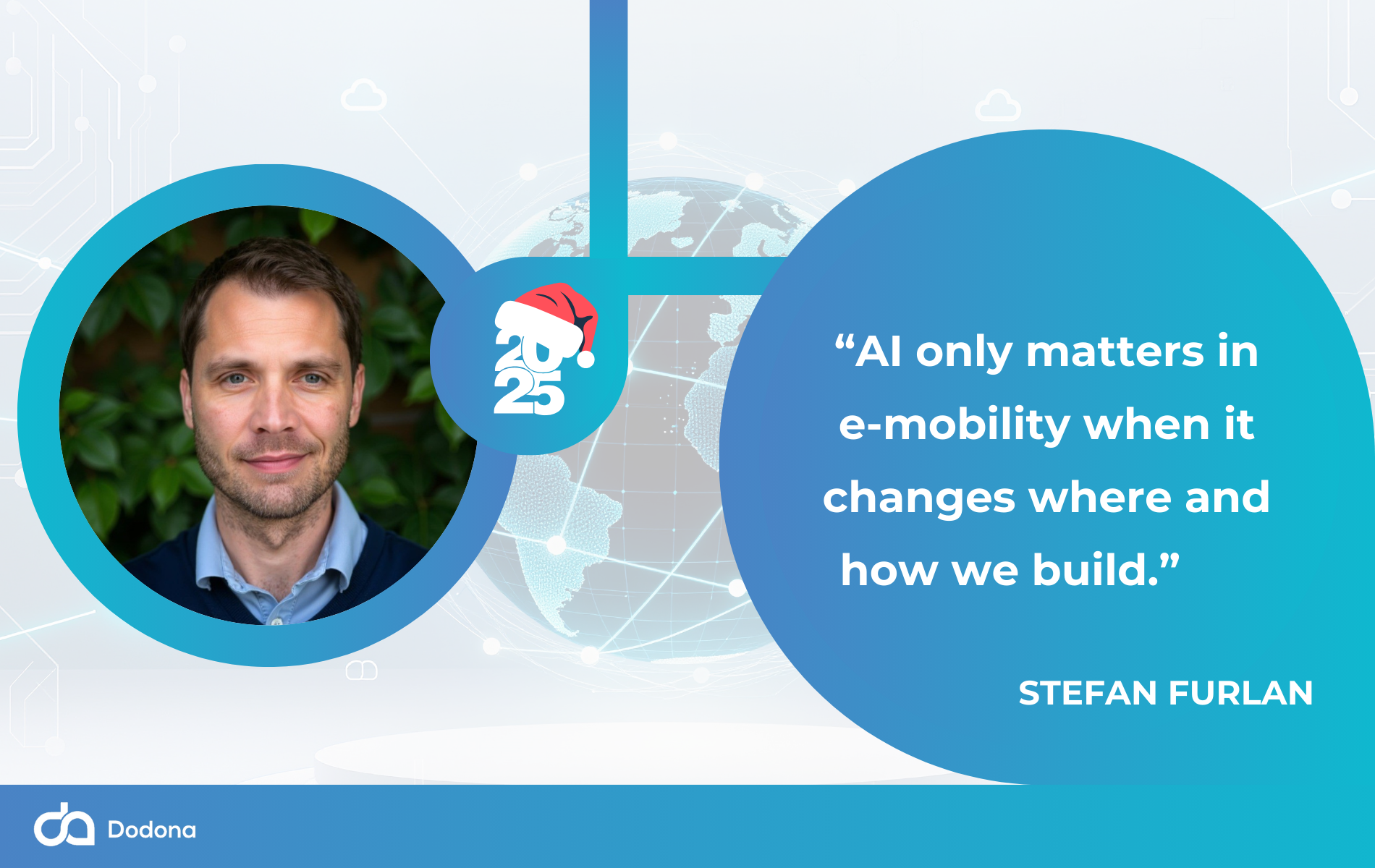
From my perspective, 2025 was a lot about AI, and in the context of e-mobility, AI is only interesting when it changes where and how we build.
The most valuable work this year did not revolve around generic models, but around very specific questions: which sites do we prioritise, what mix of hardware do we install, and will those assets still make sense in 10, 20 years?
On the ground, that meant using AI to understand private parking availability, parking density, and physical constraints, then combining that with demand, grid, competition, and regulation to score portfolios of locations rather than single sites. It meant embracing “small data, strong opinions”, capturing moving demographics (early enthusiasts turning into early adopters), landlord incentives, and local politics alongside the kWh and traffic flows.
Looking slightly ahead, electrified fleets will further shift the definition of an “ideal” site. Looking a bit further ahead, we need to start thinking about autonomous vehicles. We’re shifting from human‑convenient to machine‑ and grid‑convenient, as concepts like driver co‑pilots, swarm charging are starting to appear in industry roadmaps.
For leaders, this leaves two important questions for 2026: how to embed AI into concrete workflows today (site scoring, forecasting, documentation, fleet planning), and how to plan for a world where AI and autonomy have quietly changed the basic assumptions of the charging business.
Stefan, visionary behind Dodona
From more data to better decisions
From the sales side, 2025 was the year conversations became more honest.
Many CPOs, utilities, and investors stopped asking for more data and started asking for better decisions:
- “Help us choose ten sites out of this hundred.”
- “Show us which depots we should electrify first.”
- “Tell us where a corridor actually makes sense, not just where funding is available.”
Several patterns kept coming up across markets.
First, the operators who treated regulation and grid constraints as model inputs instead of late‑stage surprises moved faster and lost fewer deals to delays.
Second, there was a visible gap between markets where growth is subsidy‑driven and those where affordability is the main lever: in Europe and the US, long‑term policy and grants still shape demand, while in countries like Mexico, it is the total cost of ownership that pushes fleets and drivers towards EVs.
Third, corridor and depot projects exposed just how fragile manual processes still are. Documentation, connection requests, and stakeholder coordination became bottlenecks unless teams had a repeatable, data‑driven workflow.
Looking into 2026, the most sophisticated customers are no longer asking “if” they should use a planning platform; they are asking how to integrate it into their weekly decision rituals. The opportunity now is to help more of the market make that leap from one‑off studies to an ongoing, model‑driven way of running their charging business.
Chris, making honest sales conversations useful
The good, the bad, and the (slightly) ugly
From an engineering perspective, 2025 confirmed two things: EVs are here to stay, and they’re genuinely a pleasure to drive. I joined the club this year and can’t imagine going back. From the moment you live with an EV day‑to‑day, it becomes very hard to argue that this is a temporary transition technology rather than the new default.
The market itself is consolidating fast, and that cuts both ways. On the one hand, bigger players and tighter integration should bring more efficiency, better uptime, and fewer “experimental” business models that were never going to work at scale. On the other hand, the market will consolidate, and the question is who is going to survive?
The next few paragraphs are likely to get technical. If you don’t have the appetite for it, turn away.
Under the hood, this is forcing a more serious or enterprise approach toward technology and software. It is no longer enough to stand up chargers; operators need systems that can automate edge cases, manage complexity across fleets, depots, and public networks, and keep performance high without just throwing more people at the problem.
As much as I am technical, I like to solve problems. And that is where decision platforms like Dodona matter most: turning messy, real‑world constraints into something teams can actually act on every single moment, and why we have been quietly building the next generation of AI‑powered planning tools in the background.
AI, meanwhile, remains both a driver of progress and a risk. Or to put it simply: I love AI, but I am human. It is already making applications and development better, faster, and more scalable: from auto‑generated test cases and smarter monitoring to copilots that remove a lot of friction from everyday engineering work. The ugly side is that the same tools can also push teams in the wrong direction if they are used as a replacement for thinking rather than a way to sharpen it, or if they are allowed to encode existing biases and bad assumptions at scale.
The challenge for 2026 will be to keep focus on what matters most and where technology adds value to your business.
On the product and engineering side, that means being very explicit about where AI belongs in the stack, forecasting, anomaly detection, documentation, workflow automation, and where human judgment has to stay firmly in the loop.
Culturally, it means resisting the temptation to ship “AI‑powered” everything and instead using it to do the unglamorous work that makes planning, building, and operating charging networks a little bit more robust every week. That is the bar we are setting for Dodona’s own AI features as they move from internal prototypes to something customers can touch.
Boris, providing the tech

Turning decisions into product
From a product perspective, 2025 was the year planning platforms had to grow up from “nice analysis slides” into the place where decisions happen, and the planning process takes place.
Working with leading global CPOs, teams no longer wanted another report; they wanted a single surface where they could see their network, fleets, depots, policy, and grid constraints in one place and decide, every week, what to do next.
Across markets, the same pattern kept repeating: too many tools, too many exports, and too much critical logic stuck in people’s heads. What resonated most were products that could sit in the middle of that mess, providing evidence and orchestration to give clear, simple answers to high‑stakes questions:
- “Which ten sites do we build next?”
- “Which depot breaks first if this fleet contract lands?”
- “What does this policy or incentive change do to our rollout in the next 24 months?”
AI showed up here as infrastructure rather than a feature. The useful parts were not flashy copilots, but the quieter pieces: better forecasts and scenarios, automatic documentation, and smart prompts that highlight risks before they become delays.
Going into 2026, the focus for Dodona is to keep pushing in that direction: Make Dodona the place where CPOs, fleets, investors, and OEMs come each day to align on one model of reality and turn it into a series of confident, defensible decisions.
Phil, providing solutions to customers challenges
Building right in 2026
As we head into 2026, the EV charging market is entering a more disciplined phase. We are moving from “build fast” to “build right.” The winners will be the teams who can consistently answer three questions before CapEx is committed:
- Where will demand actually show up?
- What will it cost to energise
- How will this site perform inside the portfolio you already have?
Grid connection reality, reliability expectations, and tighter capital are pushing everyone towards better decisions earlier. That means fewer vanity sites, more repeatable playbooks, and much sharper prioritisation across hubs, corridors, and destination charging.
My bet for 2026: the best CPOs will prioritise portfolio outcomes, not individual site wins, using data to stress-test timelines, costs, and competition instead of trusting one headline score. The industry is maturing, and that’s positive.
Junaid, looking for problems Dodona can solve
.png?width=1900&height=1200&name=Junaid%20(1).png)
In short
2025 forced the industry to look past headlines.
Growth was real, but so were the gaps: between subsidies and sustainable business models, between mapped coverage and real‑world driver experience, and between AI as a buzzword and AI as a tool that quietly improves decisions.
Across all of these perspectives, the common thread is that nobody can afford to guess anymore. Where and how you build, which sites you prioritise, how you navigate policy shifts and grid constraints, and how you use AI without outsourcing your judgement are now the questions that make or break a strategy.
For Dodona, 2026 is about turning those questions into a routine, not a once‑a‑year exercise. That means treating regulation and incentives as data layers, making electric vehicle users first‑class citizens in every plan, and using AI as part of the infrastructure that supports better decisions instead of a side project.
If you are rethinking how and where to build your network next year, Dodona is where these conversations are already happening. If you want to compare notes, see what the most forward‑thinking teams are doing, or explore how decision intelligence could fit into your 2026 rituals, the team is always one call away.
Visit: https://thedodona.com/
Want to learn more now? Let's chat.