Resources
Free research!
Aside from our premium content, all of our content is available without you needing to share your contact details.
But if you would like to learn more, see a demo or chat about the value our customers have seen from using our platform, please do not hesitate to get in touch.

case studies
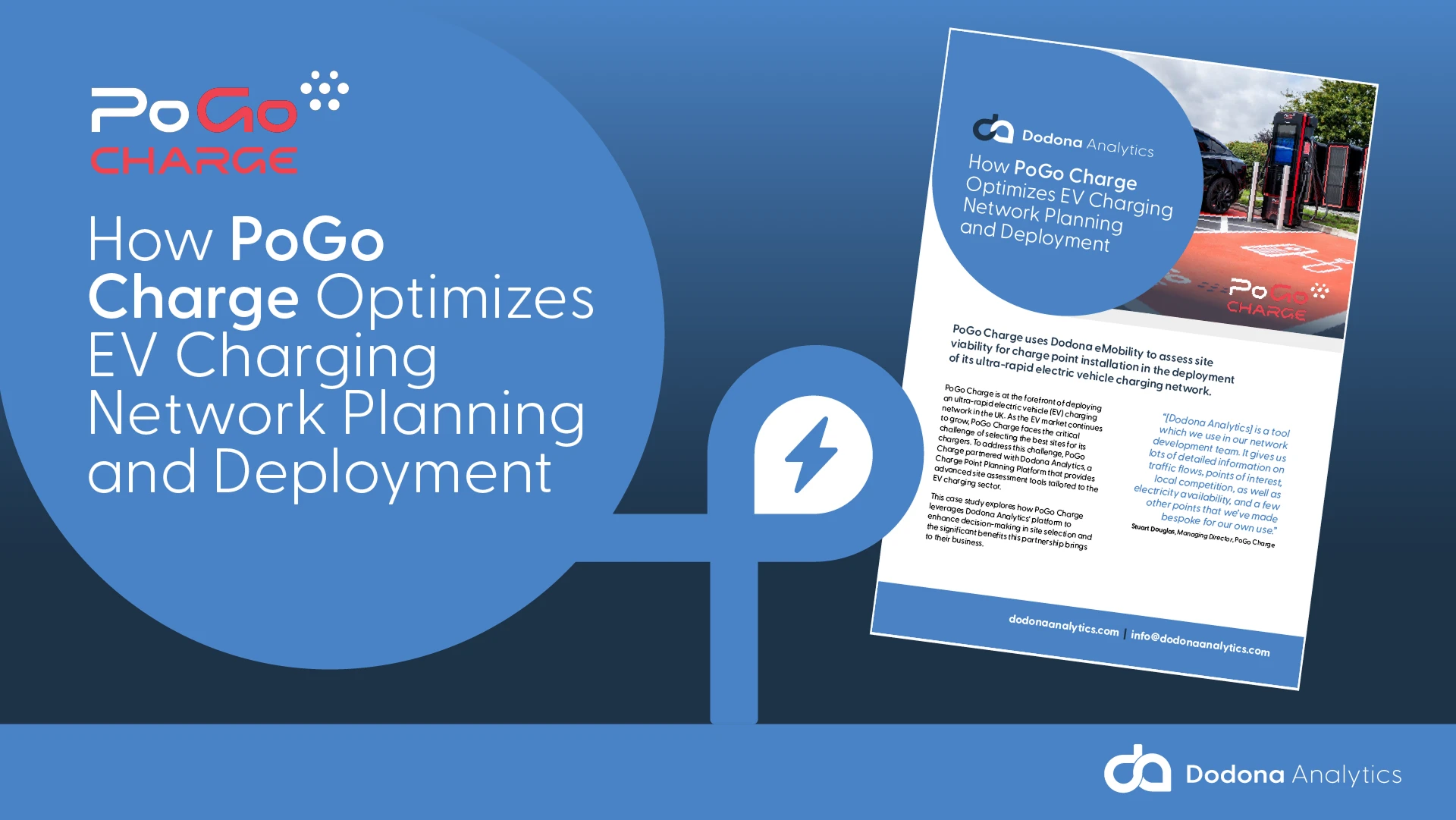
PoGo Charge
PoGo Charge is fast growing UK-wide EV charging network offering ultra-rapid, rapid and destination charging for electric vehicle drivers.
This case study shares how PoGo Charge leverages the Dodona Analytics platform to quickly assess site feasibility and viability to scale its network and the significant benefits this partnership brings to its business. It shares:
- The challenges of scaling a CPO
- The opportunity to move from complex spreadsheets
- 10 solution benefits

Download

FOR EV
FOR EV is a leading provider of EV fleet electrification, working with major clients such as Network Rail Scotland, public bodies, and the private sector.
FOR EV needed complete confidence in its site assessment process, and this case study explores how FOR EV utilizes the Dodona Analytics CPP platform and the benefits this has brought to the business versus their previous process:
- Assessing 500 sites in the time it took to review one
- Focus on good sites with faster site rejection
- Strong reporting and investment readiness
Download
webinars on-demand

Exploring the Charge Point Planning Market
Industry expert Jeff Clark, Principal Analyst from cleantech insiders joins our co-founder, Chris Chamberlain, to share his latest research into the charge point planning market.
registration required

Watch replay

The Challenge of Happy Chargers
Industry expert Francisco (Paco) Aguirre, Founder, CEO/COO, synergEV joined us for a chat about how to create happy chargers.
registration required
Watch replay

newsletter
Join our community of over 2000 EV experts
Sign up for our monthly newsletter and get the latest EV charging planning tips, news, and insights.

on video

Fireside chat with Stuart Douglas from Pogo Charge
Our friends at Pogo Charge invited our co-founder Chris Chamberlain to have a chat with their MD, Stuart Douglas, to discuss the business of EV charging, how Dodona can help and what they see is the future for EV charging.

Watch on YouTube

Dr Stefan Furlan chats with Asif Ghafoor, CEO, Be.EV
In this conversation, Asif shares the evolution of his business over the last four years working with Dodona, the importance of data analytics in their decision-making, and the innovative approach Be.EV have taken to creating community-focused charging solutions.
Watch on YouTube
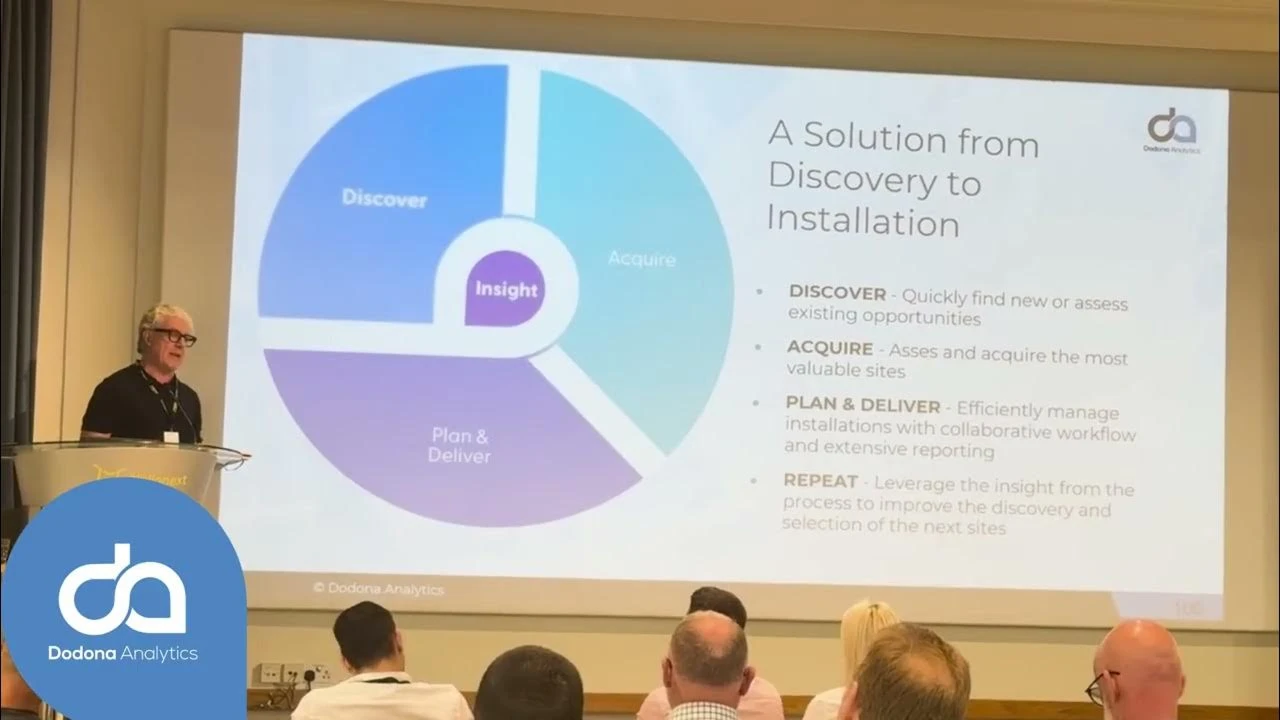
Chris Chamberlain speaking at Hellonext's AMPED UP event
Our co-founder, Chris Chamberlain, talks about some of the challenges facing the EV industry and how Dodona Analytics can help at the recent Amped Up industry event.
Watch on YouTube
eBooks
Shareable insight offered free with no need for you to share your contact details.

The Secret Sauce of Successful Charge Point Operators
Explore why Dodona is considered a "secret sauce" and the ingredients that make companies successful in EV charging.
Download

The Business Case For Charge Point Operators
Explore global trends and opportunities for CPOs despite market softening, with insights across UK, US, and EU markets.
Download

The 4 Stages for Success in Site Selection
Four key steps that successful CPOs follow when building commercially profitable charging sites.
Download

Charging Forward with Smart Data
A practical guide to accelerating EV infrastructure and business growth through data-driven decisions.
Download

premium content

The Charge Point Planning Market
- 3 business approaches for CPOs
- 8 success factors for EV charger locations
- 10 must-have capabilities in a CPP platform
This premium content link will take you to a registration page and requires your contact details, which, in accordance with our privacy policy, we do not share.
Download Report
brochures
More information about our product and services to download and share.

Platform Overview
Get an overview of our platform and how it supports ambitious EV charging planners through the entire process, from discovering new sites, to acquiring them, through the entire planning and delivery process.
Download

Expert Services
Our team has direct hands-on experience working with a wide range of charge point operators, their business models, and specific needs. As such, we have a tried and tested process for organizations new to our platform.
Download
infographic
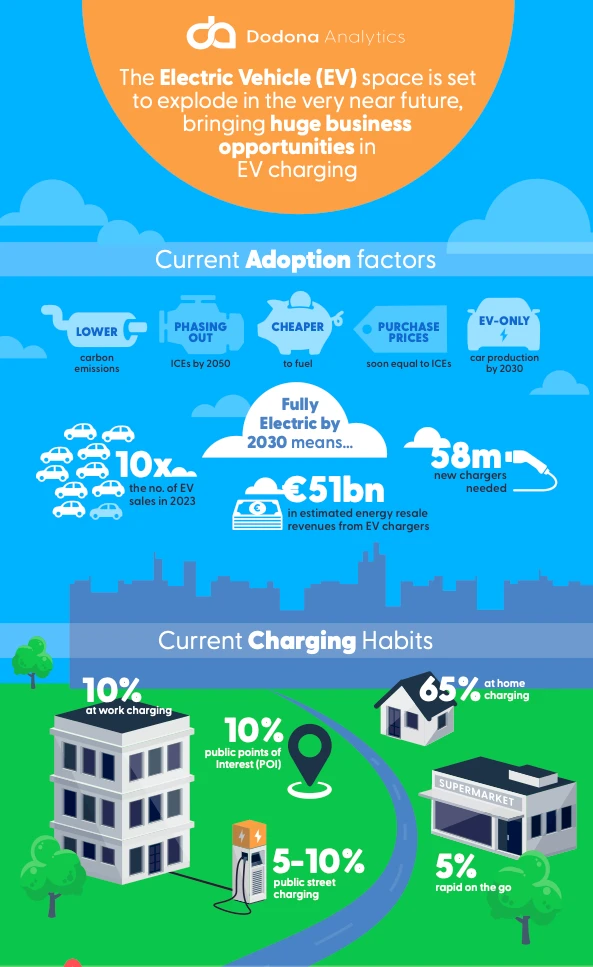
The Emerging EV Charging Landscape
The Electric Vehicle (EV) space is set to explode, bringing huge business opportunities in EV charging. That's according to recent Flashpoint Venture Capital research. We shared the details in this blog post, and we've also created this infographic.
Download Infographic
blog
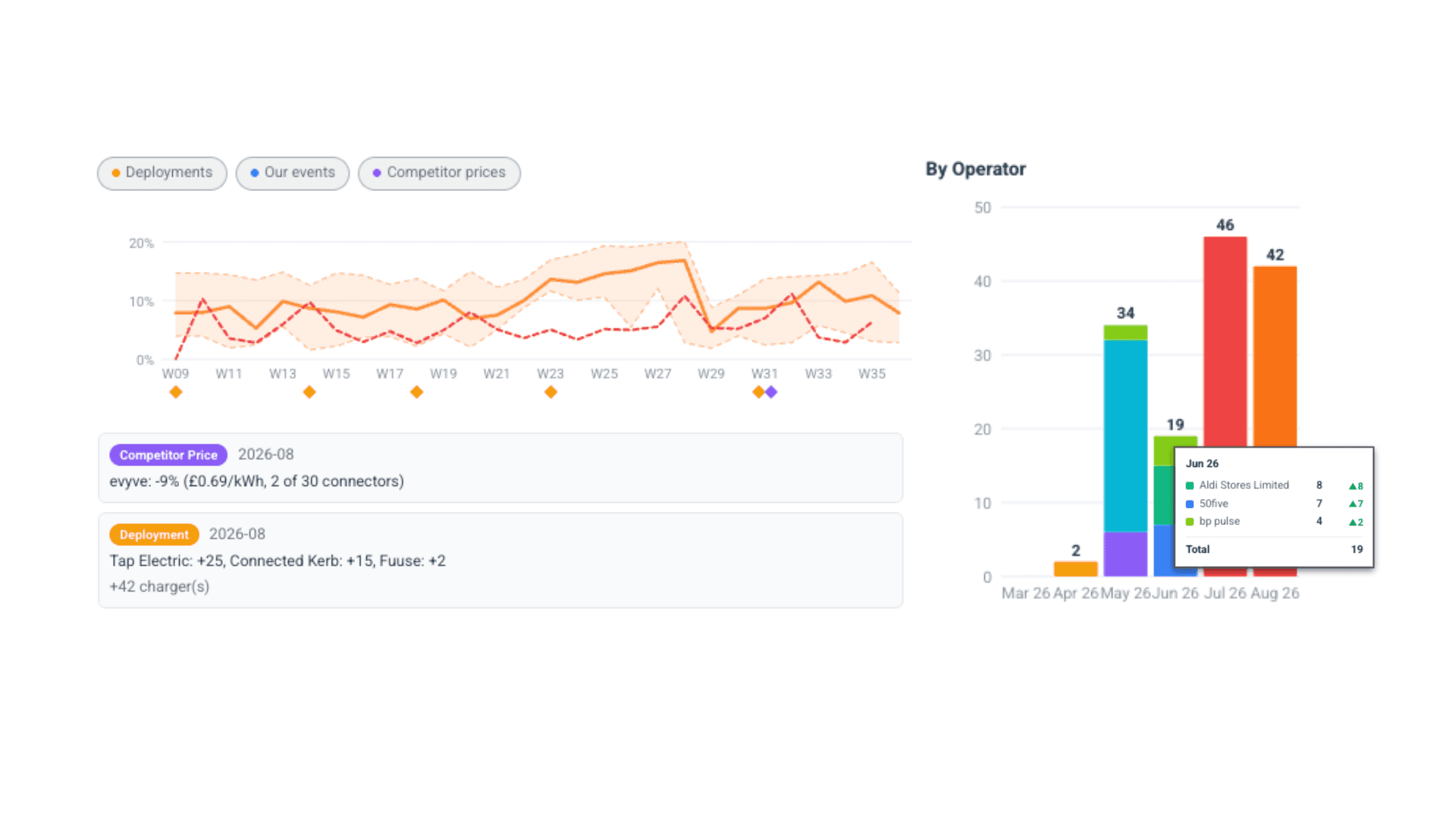
Most CPOs cannot answer the only question that matters. We think we can.
Stefan Furlan, CEO, Dodona
One of your sites went quiet in April. You found out in May.
Then the real work started. Zapmap, to see whether anyone had built nearby. A news search, in case there was a press release. Two competitor apps, to check their tariffs. A spreadsheet to hold it together. By the time you had an answer you believed, the quarter had closed and the site had been quiet for two months.
If you run a charging network, I suspect you have lived some version of that. I have watched charge point operators describe it, in almost identical terms, in nearly every conversation we have had this year.
The only question that matters
Three weeks of work, and at the end of it you still would not bet the quarter on the answer.
The question is just: why.
Everything follows from it. You cannot price against a competitor you have not noticed. You cannot fix a fault you have spent a month calling a demand problem. You cannot defend a site to a board, or to a lender, without knowing what actually moved.
And here is the thing that has been true for as long as this industry has existed.
When the reason sits inside your fence, you can answer it. Your systems are built for exactly that and they are good at it. Sessions, energy delivered, faults, revenue per charger, down to the connector.
When the reason sits outside your fence, you cannot. Not slowly, not approximately. You cannot.
Twelve new bays opened four hundred metres away. A rival dropped its tariff by seventeen percent. The whole local area dipped because the retail park spent six weeks resurfacing its car park. Nothing in your data will tell you any of that, and all three will show up as your site underperforming.
There are five families of cause and your own data sees one of them clearly. We wrote up the full set in a separate diagnostic guide, so I will not repeat it here.
Why this matters more than it did
None of the above is new. What has changed is what the market pays for.
Strategy& found this year that utilisation and asset productivity now sit among the top priorities for almost sixty percent of European operators. The capital coming into the sector has changed shape too. The large financings announced by European operators since the start of 2025 have arrived overwhelmingly as debt and green loan facilities rather than equity, and debt underwrites performance in a way equity never had to.
At the same time, Zapmap and the Green Finance Institute put UK ultra-rapid utilisation at 12.8 percent in the fourth quarter of 2025, against 12.4 percent a year earlier, while ultra-rapid capacity grew forty percent over the same period. Zapmap reads that as resilience, and they have a fair case. I read it as a flat line on revenue per charger during a period of heavy investment.
Building is not finished and will not be for years. But the returns question has moved. For most CPOs it is no longer only where to build next. It is whether the assets already in the ground are doing what they were underwritten to do. Which takes you straight back to why.
Every piece of the answer exists. Nothing joins them.
Here is what I find odd about our industry. Almost every input needed to answer that question already exists somewhere.
Your CPMS holds your sessions. A monitoring tool holds your faults. A mapping service holds who is where. Somebody's press release holds the price change. A planning tool holds the traffic and the demographics.
None of them are joined. So the joining gets done by a person, manually, in a spreadsheet, after the fact, for the handful of sites somebody had time to look at. Which is exactly why it happens monthly rather than daily, and why it stops entirely in a busy week.
Where our data comes from
I will be short about this, because it is the part of the business we guard most closely.
Dodona has spent years building what we believe is the most complete and most accurate picture of the charging market that exists. Every public charger, who runs it, what it charges, how heavily it is used, and the traffic, demographics, vehicle parc, demand conditions around it and so much more. It is why operators come to us to decide where to build, and it is the reason our site assessments still hold up once the site is live.
Until this year, all of that pointed forwards. It answered one question. Where should we build next.
This year we pointed it backwards, at the assets already in the ground.
The same picture that tells you a site is worth building tells you, once it is live, why it is not performing. Same data, second question. As far as I can tell, nobody had asked it.
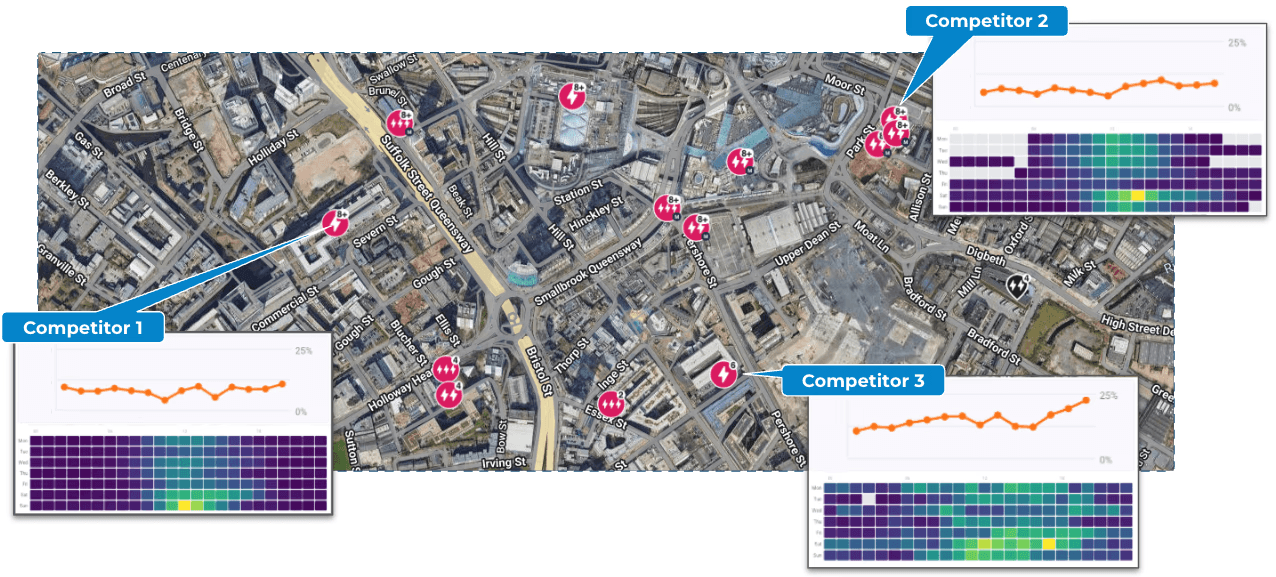
Charger by charger across one city catchment. Not a network average, and not our own estate.
What we built
Network Optimisation is the result. It is the operating layer for a network that is already live, and it sits above the systems you run rather than replacing any of them.
It watches your network and the market around it. It tells you when something moves, on either side. It ranks what it finds by the annualised revenue at stake rather than by a percentage, so the list arrives in the order a commercial owner would choose. Then it holds each action open until somebody can show it worked, against the number that was forecast when the action was created.
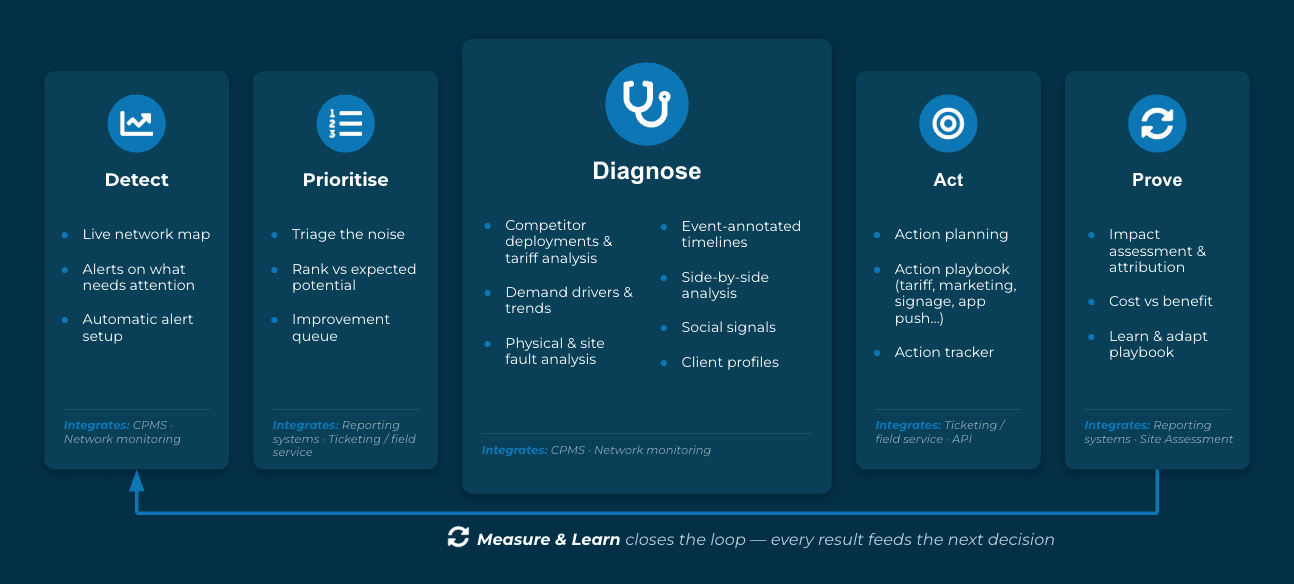
Detect, prioritise, diagnose, act, prove. The last step is the one that makes the next decision better.
That last part is the one I would defend hardest. Plenty of tools will tell you something is wrong. Very few will tell you whether the fix paid for itself, and without that the loop never closes and nothing compounds.
What to actually do once you know the cause is a separate question, and a practical one. We wrote up twenty three of the moves operators actually use, from tariff changes to signage to switching a site off for a period.
What surprised us
Every operator we showed this to already had dashboards. Good ones. In a couple of cases more granular than ours, built on their own session data and watched every day.
Not one of them had any view of what was happening outside their own estate.
That reframed what we were building. The gap was never reporting. CPOs report on themselves perfectly well. The gap is that the reporting stops at the fence, and the reason a site underperforms is usually on the other side of it.
If any of this sounds familiar
We are running Network Optimisation with a small group of design partners now, and opening it more widely after that.
If you run a charging network and the first paragraph sounded like your last quarter, I would like to talk to you.
You can put time straight in my calendar here.
Stefan
Read More

23 ways CPOs fix underperforming sites: the remedy playbook
Article 2 of 2. Companion piece: Why chargers underperform
Profitability is the slide every charging board deck now ends on. Ask most operators how they get there, and the answer involves growth: more sites, more hardware, economy of scale.
The market has started moving the other way. Zapmap noted in mid-2026 that operators are shifting focus toward utilisation rather than deployment, and that poorly performing chargers are being pulled out of public use. Their utilisation work with the Green Finance Institute found usage rates holding within a narrow band through 2025 while the network grew 13%. Adding chargers is no longer the same thing as adding revenue.
So the return has to come from the estate you already own. Sites pulling half of what they should. Chargers that look fine on a map and lose money every week.
In our business, we speak with heads of operations and network performance of charge point operators across Europe. We often ask one question: when a site underperforms, what do you do about it?
Twenty-three distinct remedies came out again and again. We decided to organise these into five categories and present them systematically.
Before anything: name the cause
Every operator we speak to does the same thing before lifting a finger. They work out which kind of problem they have, because the fix depends entirely on the cause.
Bucket | The short version |
Demand | Hardware healthy, too few EVs or too little awareness in the catchment |
Physical site & visibility | The site works, drivers cannot find it, reach it or read it |
Technical / uptime & faults | Attempts happening, charges not completing |
Price & competitor activity | A rival moved, and your volume followed |
Location | Weak since day one, no event explains it |
Our companion guide, Why chargers underperform, works through the symptoms that separate these. The rest of this piece assumes you already know which bucket you are in.
The lever menu
Shares below show roughly how many of the operators we spoke with raised each remedy. We have rounded them, and we name no operator, because several of these remedies came from a small number of teams who would be identifiable otherwise.
Pricing
The most-discussed category, at around a quarter of everything raised.
Remedy | Share of operators | When it fits | Check it worked |
Cut price or run a targeted discount (network, hub or socket level) | 75% | A rival cut their tariff, or a healthy site with room above the cost floor | Utilisation and kWh against control sites; margin per kWh stays above floor |
Hold and do nothing through a short competitor promotion | 65% | The promotion is time-boxed, and your network is sticky enough to ride it out | Does utilisation recover on its own once the promotion ends? |
Time-of-day pricing to move demand into quiet windows | 35% | Sharp peak and trough pattern with spare capacity off-peak | Off-peak session growth without eroding peak margin |
Price is the first reflex almost everywhere. The more interesting position, raised nearly as often, is knowing when to sit on your hands. Several operators described watching a rival run a time-boxed deal nearby, holding their own tariff, and waiting for volume to come back. Cutting in response starts a race nobody wins.
Some teams also cap how far they will discount, because a tariff change carries operational cost of its own once you count reboots and comms. Before you move, benchmark: Zapmap put the July 2026 weighted average pay-as-you-go price at 54p/kWh up to 49kW and 80p/kWh at 50kW and above. If you sit below market and still lose volume, price is not your problem.
Marketing & demand
Around a quarter of everything raised, and the category operators reach for fastest once the hardware checks out.
Remedy | Share of operators | When it fits | Check it worked |
Hyperlocal promotion in a tight radius around the site | 55% | Site is healthy, but nobody local knows it exists | New users inside the radius; session uplift against baseline |
Flyer and leaflet drops | 45% | Residential areas with little off-street parking, or a brand new site | Sessions and new users in the weeks after the drop |
Fleet and B2B deals for quiet windows | 35% | Consistent dead hours plus depots nearby | Contracted off-peak volume; blended site utilisation |
App push to drivers near the site | 10% | You have an app user base in the catchment | Push-to-session conversion against a hold-out group |
Win-back after a failed charge or a fix | 10% | Failed-charge events, or a site you have just repaired | Return rate of contacted users |
One rule governs this whole category: never market a site you have not verified. J.D. Power's 2025 US study found 14% of EV owners visited a charger and left without charging. Spending to send new drivers into that experience buys you churn at full price.
The win-back move deserves more attention than its share suggests. Operators describe EV drivers as fickle, so a plain apology after a failed session, plus a nudge to lapsed users once the site works again, recovers sessions for close to nothing. Very few teams run it as a process.
Resident-engagement work on foot comes up from operators running kerbside estates, where the driver has no driveway and no alternative. With on-street charger numbers growing 18% year on year through H1 2026 according to Zapmap, more operators will need this muscle than currently have it.
Physical site & visibility
The smallest category by share, at roughly one mention in eight, and the one with the cheapest wins in it.
Remedy | Share of operators | When it fits | Check it worked |
Signage and wayfinding | 35% | Healthy site that drivers cannot find | Session uplift; first-time-user share |
Dedicated EV bay plus anti-blocking enforcement | 20% | ICEing, bay blocking, overnight squatters | Availability percentage; share of long blockers |
Site visit or manual inspection | 20% | Unexplained drop with a suspected silent fault | Faults found and fixed, logged against the cost of the visit |
Vinyl wrap or on-charger branding | 10% | Low visibility in a large car park | Sessions and new users after the wrap |
Site visits find real problems. Teams that drive their estates turn up payment screens bleached by sunlight, losing customers with nobody any the wiser. But a person walking a large estate is the most expensive diagnostic tool you own. Keep it rare, send it with a hypothesis, and log what each visit cost against what it found. Some operators are piloting crowdsourced field checks as a cheaper way to get eyes across an estate.
Technical / uptime & faults
Roughly one mention in five, and the category where the cheapest remedies live.
Remedy | Share of operators | When it fits | Check it worked |
Triggered remediation workflow with a verify step | 35% | Any confirmed issue that has a defined response | Share of issues resolved without human handling; post-action utilisation |
Remote reset, reactive and preventive | 20% | Status faults, or a known quirk on that charger type | Fault recurrence rate; first-time success percentage |
Hardware repair: water ingress, drainage, screens, comms | 20% | Physical faults after storms or sun exposure | Uptime; contactless payment share |
Escalate to the DNO, CPMS or charger vendor | 20% | Root cause outside your control, such as grid overvoltage tripping units | Trip incidents; time to resolution |
Firmware selection by charger type | 10% | A hardware type where versions fail at different rates | First-time success by firmware version |
Crowdsourced field checks | 10% | Cheap eyes across a large estate | Cost per verified issue against manual visits |
This category has changed status. It used to be a margin question. Since the Public Charge Point Regulations came into force, a rapid network has to hit 99% reliability as an annual average, reported to the Secretary of State. One secondary source cites a 2025 Monta survey of over 200 UK operator decision-makers finding fewer than 4% already meeting it. Worth verifying at source, but the direction is clear enough: technical remedies now defend a compliance number as well as a margin number.
Strong teams resolve most of this without leaving the office. A remote reset the moment a status fault appears. A restart scheduled around a known quirk for that hardware type. An engineer only once the fault is confirmed physical. And when the cause belongs to someone else, they route the ticket to the DNO or the manufacturer instead of burning their own hours on it.
Firmware selection is the most underused item on this list. A few teams use a third-party service that tells them which firmware version performs best for a given charger type, then deploy accordingly. Most operators run whatever shipped.
Portfolio / strategic
Roughly one mention in five, and the category that decides whether any of the others compound.
Remedy | Share of operators | When it fits | Check it worked |
Feed what you learn back into site selection | 55% | A repeating pattern explains your good and bad sites | Forecast accuracy against actuals on the next deployments |
Decommission or divest chronic losers | 20% | Still weak after every reasonable fix | Portfolio margin; return on the freed capex |
Set utilisation targets and rank the outliers | 20% | Always, as the cadence that starts everything else | Number of outliers actioned; movement against target |
Relocate the charger | 10% | Wrong location, permanent obstruction, contract permitting | Utilisation at the new site against the old |
Switch off temporarily, with a reminder to switch back on | 10% | Known disruption such as streetworks | Avoided dead-charger losses; on-time reactivation |
The most valuable item here is the one operators mention most and formalise least. What you learn fixing one site should decide where you build the next. A rival's strong site nearby is either a signal to follow or a reason to stay away, and the answer sits in your own recovery data.
Operators running large mixed estates put the harder version plainly: at some point you stop spending on locations that will never pay back, and you move that capex to the ones that will.
Run it as a loop, not a rescue
Every strong operator describes some version of the same cycle.
A site slips. An alert flags it.
You diagnose the cause.
You pick the remedy that will most likely fix the cause.
You do it.
You go back and check whether utilisation recovered.
You analyse, learn, and capture the lesson for next time.
Step five is the one a lot of CPOs skip. Skip it and you never learn which lever works on which kind of site, so next quarter you guess again. Teams that formalise it name the stages: alert, diagnose, plan, in progress, verify. The last stage is where the compounding happens.
A cadence that holds this together, from the operators who run it best:
Weekly: rank sites by the gap against what they should do. Work the top of the list.
Monthly: review the fixes currently running. Did the number move?
Quarterly: count which causes dominated your estate, and update your playbook accordingly.
Where the manual version stops working
Scale breaks this. Plenty of European operators now run estates well past a thousand chargers.
You cannot rank a thousand sites by hand every week. You cannot hold the likely cause of each weak one in your head. And you certainly cannot recall, six weeks later, whether the tariff change at site 412 moved the number or whether the season did.
So the loop degrades into a rescue. Whoever shouts loudest gets attention, the same three sites get fixed twice, and the verify step disappears. Operators with large estates describe some version of this without being asked.
What we built
Dodona Network Optimisation exists for this job.
It ranks every site in your estate by the gap between what it pulls and what it should pull, so you open Monday with a list instead of a hunch. For each weak site, it names the likely cause, whether that is demand, price, a fault or placement, so you know which bucket you are in before you spend. Where it can, it triggers the remedy itself, such as a remote reset off a known fault, then writes the outcome back so you can see whether the action moved the number.
Diagnose, act, verify. Across a thousand chargers, without anyone babysitting the list.
We are opening a beta to a small group of operators, and several networks are already in. Bring your five worst sites, or your own data if you are up for it, and we will rank them live in about ten minutes. Reply to this, and we will find a slot.
Sources
Zapmap and Green Finance Institute, UK charge point utilisation report, 2026
Zapmap Price Index, July 2026, and UK charging infrastructure statistics, H1 2026
J.D. Power, US Electric Vehicle Experience Public Charging Study, 2025
The Public Charge Point Regulations 2023, regulation 7
Monta UK charge point operator survey, 2025
Read More

Why EV chargers underperform: A diagnostic guide
Companion piece: 23 ways CPOs fix underperforming sites: the remedy playbook
A charger can report 99% uptime and still turn away one driver in three.
That gap is the most useful thing to understand about charging operations right now. ChargerHelp's 2025 analysis of more than 100,000 sessions across 2,400 chargers found reported uptime running between 98.7% and 99.9%, while only 71% of charging attempts succeeded on the first try. Even more uncomfortable: 35% of those failures occurred on chargers that appeared operational. The data is American, and UK numbers will differ, but the mechanism travels. Your dashboard is green. Your driver is gone.
The same gap exists one level up. A site can look acceptable relative to your network average and still pull in half of what it should for its location.
Both gaps cost the same thing: margin. Profitability sits on every board slide in this industry now, and the cheapest route to it runs through chargers you already paid for. Getting there starts with knowing what is wrong with them, because the wrong diagnosis spends real money and moves nothing.
In our business, we speak with heads of operations and network performance of charge point operators across Europe, and with advisors who have worked on thousands of chargers. This guide sets out what those teams look at when a site slips, the five families of cause, the symptoms that separate them, and what each wrong diagnosis costs. The companion piece covers the 23 remedies that follow.
1. Define underperformance properly
A site underperforms when it pulls less than it should for its location. The average is what hides your problem. A mean built from 400 healthy sites and 40 dying ones reads as acceptable right up until the year-end margin lands. Zapmap and the Green Finance Institute found time- and energy-based utilisation rates moving within a narrow band across every power category through 2025, even as the network grew by 13% and delivered energy grew by an estimated 21%. Aggregate stability tells you nothing about the spread underneath it.
Operators who run this well score each site against an expectation built from its own context: local EV density, traffic, dwell time, competing chargers within the catchment. Then they rank by the gap. Some teams keep a worst-against-achievable list so the operations meeting opens with names rather than a dashboard.
That gap is your starting point. The rest of this guide explains what fills it.
2. The five families of cause
Demand
The hardware works. The bay is clear. There are not enough EVs within reach, or the drivers who are there have never noticed the site.
Symptom signature. Healthy success rate, low session count, flat trend with no step change. New sites show a slow ramp rather than a drop.
How to confirm. EV registration density in the surrounding postcodes against the assumption in your site case. First-time-user share at the site: if it sits near zero while repeat use holds, awareness is your problem rather than driver behaviour.
What operators tell us. Kerbside teams keep returning to housing stock. A street where most residents have no driveway behaves nothing like a street where most do, and the second one will underperform for years whatever you spend on marketing.
Cost of calling it wrong. You cut the tariff at a site with no drivers in range. You lose margin on the few sessions you had and change nothing else.
Physical site & visibility
The most common cause that never appears in a fault log is that nothing has failed.
Symptom signature. Sessions well below comparable sites nearby with similar traffic. Long unexplained availability gaps, which usually mean a blocked bay rather than a fault.
Specific cause | How it shows up |
Bay position in the car park | The charger sits behind the building, or in the row nobody drives down |
ICEing and bay blocking | Availability reads poor, hardware reports healthy |
Missing or weak signage | Drivers pass the entrance; first-time-user share stays low while repeat use holds |
Charger reads as unbranded | Drivers do not recognise the network and use one they trust |
Screen unreadable in direct sun | Sessions collapse across summer months at south-facing sites |
How to confirm. Photographs beat data here. Teams that drive their estates turn up payment screens bleached by sunlight that have been losing customers for months. Nobody reports it because a driver who cannot read a screen does not file a ticket, nor do they return.
Cost of calling it wrong. You run a hyperlocal campaign that successfully drives people to a bay a diesel van has occupied since Tuesday.
Technical / uptime & faults
Symptom signature. Success rate below your network norm. Sessions started well above sessions completed. Faults recurring on the same units.
Specific cause | How it shows up |
Firmware version | Two units of identical hardware fail at different rates. A few teams use a third-party service that tells them which version performs best per charger type |
Water ingress and drainage | Failures cluster after storms, often at the same low-lying sites |
Payment terminal failing silently | The unit reports online. Cards decline. No fault ticket exists |
Grid overvoltage | Chargers trip repeatedly through no fault of your own. The cause sits with the DNO |
Connectivity | Sessions fail to start or fail to bill in a known weak-signal location |
How to confirm. Cut success rate by charger type, by firmware version and by site age. The comparison usually names the cause on its own. A pattern that follows hardware points at firmware or the vendor. A pattern that follows geography points at grid or comms.
Age matters more than most operators budget for. The ChargerHelp analysis found first-time success falling from 85% at new stations to below 70% by year three. Your 2023 cohort is quietly becoming your problem cohort.
Cost of calling it wrong. This is the expensive one. You market a broken site, and every new driver you attract has a failed first experience. J.D. Power's 2025 US study found 14% of EV owners visited a charger and left without charging. You paid to create those visits.
Price & competitor activity
Symptom signature. A step change, not a curve. Utilisation drops on a date. Sessions shift to a competitor while your success rate stays perfect.
How to confirm. Find the date the drop started, then find what changed in the catchment on that date. Benchmark your own tariff while you are looking: Zapmap put the weighted average pay-as-you-go price in July 2026 at 54p/kWh up to 49kW and 80p/kWh at 50kW and above. If a competitor launched a time-boxed promotion, your problem has an end date and may need no response at all. Several operators describe watching a rival run a time-boxed deal, holding their own tariff, and waiting for volume to return.
Cost of calling it wrong. Two ways to lose. You match a promotion that would have ended anyway and start a race down. Or you sit still through a permanent repricing and lose a year waiting for a recovery that never arrives. The difference between those two mistakes is knowing whether the competitor's move has an end date, so establish that before you touch your own tariff.
Location: wrong from the first day
Symptom signature. No event explains the weakness, because there was never a strong period. The site launched flat and stayed flat.
How to confirm. Compare actual traffic and dwell time against the assumption in the original site case. This is uncomfortable work, since it audits a decision somebody in the business already made and defended.
Cost of calling it wrong. You spend three years cycling remedies through a site that no remedy reaches. Operators who run this well set a limit: after a defined set of interventions, a chronic loser gets switched off, sold, or moved, and the freed capex goes to something that can pay it back. Operators running large mixed estates describe exactly this call. Zapmap has started to see it in its own data, noting that poorly performing chargers are being taken out of public use.
3. The moves your own data can't see
Some causes hide inside your estate. Others sit entirely outside it, and those are the ones your dashboard is built to miss.
Your reporting shows your own sessions, uptime, and tariff. It shows nothing about the catchment around a site. A competitor opening two miles away. A rival cutting its pay-as-you-go rate last Tuesday. Either can pull a healthy site's volume down within days, and neither leaves a mark in the system you use to watch for trouble. The site reads fine on every internal measure. Success rate perfect, hardware green. The drivers just went somewhere cheaper or closer.
This is why a step change matters. When utilisation drops on a given date while your success rate remains steady, the cause is almost never within the unit. Something shifted in the market that day. Zapmap recorded on-street charger numbers growing 18% year on year through H1 2026, the fastest period yet, so the chance that a rival appeared in your catchment keeps climbing. Benchmark your own price while you look. Sit at or below the market rate and still lose volume, and price is not the whole story; a nearby deployment probably is.
You cannot respond to a move you never saw. Most operators learn a rival cut prices weeks later, from a sales rep or a quarterly review, long after the volume left. Watching the catchment, not just the estate, is what lets you make that call while it still matters, instead of writing it up afterwards.
4. The revenue you have already paid for
A charger's cost is fixed. The hardware, the installation and the grid connection behind it all get paid whether anybody charges or not. That single fact decides where the money leaks.
It means an empty socket is never neutral. Every session that walks to a competitor you did not spot, and every quiet hour that passes with the bay idle, is a contribution you have already paid for and did not collect. A busy site can still lose money, and a half-empty one bleeds it slowly enough that nobody flags it until the year-end margin lands.
The first leak is price. When a rival's move is real and lasting rather than a short promotion, holding your tariff out of principle just funds their growth. When it is a time-boxed deal, matching it starts a race down that nobody wins. The difference is whether the move has an end date, which is why you establish that before you touch your own price.
The second leak is time. Most sites do not underperform across the whole day. They fill at peak and sit dead in the trough, and that trough is capacity you are paying for and giving away. Time-of-day pricing pulls price-sensitive drivers into the quiet window. A fleet or depot deal contracts the dead hours to a local operator who values a guaranteed slot more than a low headline rate. Neither touches your peak margin, and both turn idle capacity into sessions. The test is simple: did off-peak volume grow without eroding what you make when the site is busy?
None of this shows up as a fault, because nothing failed. It shows up as a site that quietly earns less than the one down the road, and closing that gap is the cheapest margin you will find.
5. Where the manual version stops working
An hour per site is affordable. A thousand sites a week is not.
You cannot rank a thousand chargers by hand every Monday, hold a likely cause for each weak one in your head, and still recall six weeks later whether the tariff change at site 412 moved the number or whether the season did. So the loop degrades into a rescue: whoever shouts loudest gets attention, the same three sites get fixed twice, and the check-back disappears.
Operators with large estates describe some version of this.
The cost is not abstract. A weak site you never diagnosed keeps paying its grid connection, its maintenance contract and its capital charge while returning a fraction of the sessions it should. Multiply that across the tail of any estate, and you have the gap between the profitability number on the board slide and the one in the accounts. Diagnosis is the cheapest lever in the business, and almost nobody runs it systematically.
What we built
Dodona Network Optimisation ranks every site in your estate by the gap between what it pulls and what it should pull, then lets you quickly analyse the likely symptoms: demand, price, competitive activity, a fault, or placement.
We are opening a beta to a select group of operators in September, and several networks are already in.
Next: 23 ways CPOs fix underperforming sites: the remedy playbook
Sources
ChargerHelp, first-time charge success rate analysis, 2025 (100,000+ sessions, 2,400 chargers)
J.D. Power, US Electric Vehicle Experience Public Charging Study, 2025
Zapmap and Green Finance Institute, UK charge point utilisation report, 2026
Zapmap Price Index, July 2026
Zapmap UK charging infrastructure statistics, H1 2026
The Public Charge Point Regulations 2023, regulation 7
Read More