One Size Does Not Charge All: Which charging scenario suits my fleet?

Fleet electrification is not simply a matter of replacing one vehicle with a comparable model. Electric vehicles represent a fundamental shift in how fleets operate, not just in what they drive, but in how, where, and when they refuel. With a combustion vehicle, the question of energy was largely invisible: fill up at the nearest station and get back on the road. With EVs, that question becomes central to every operational decision.
Fleet electrification has reached an inflection point where the question is no longer whether to transition to electric vehicles, but how to charge them effectively. And that question, where will we charge? It is far more complex than it first appears. There is no universal answer. The right charging scenario depends on operational patterns, duty cycles, site constraints, and grid capacity, and each option comes with its own distinct trade-offs.
The problem
Fleet managers consistently report confusion about where to begin their electrification journey. The challenge stems from a fundamental mismatch: what works brilliantly for office-based vehicles fails catastrophically for high-utilization delivery fleets or emergency services operating around the clock. A post office fleet that returns vehicles each evening faces entirely different constraints than sales representatives whose company cars never visit headquarters.
The stakes are considerable. Recent data from UK fleets show that charging strategy directly impacts operational costs: public charging sessions accounted for only 27% of total charging events but consumed 57% of fleet charging budgets, with costs averaging 81 pence per kWh compared to 25 pence for home charging. A poor charging strategy can transform an otherwise cost-effective EV deployment into an economic liability.
Understanding the charging spectrum
Depot and office charging
Depot charging represents the most straightforward option for fleets with predictable operational patterns. Vehicles park at a central location during operational hours (aka people in the office) and during non-operational hours (typically overnight), where AC chargers (7-22 kW) replenish batteries over 8-12 hours.
This approach works exceptionally well for office-based fleets, municipal vehicles, and any operation where vehicles consistently return to a base location. Installation costs range from $3,500 to $15,000 per charging port for AC equipment, with networked systems adding $500-$1,500 per port for remote monitoring and load management capabilities. Despite higher upfront investment, depot charging delivers the lowest per-kilowatt-hour costs and eliminates the markup premiums charged by public networks.

Home charging for return to home fleets
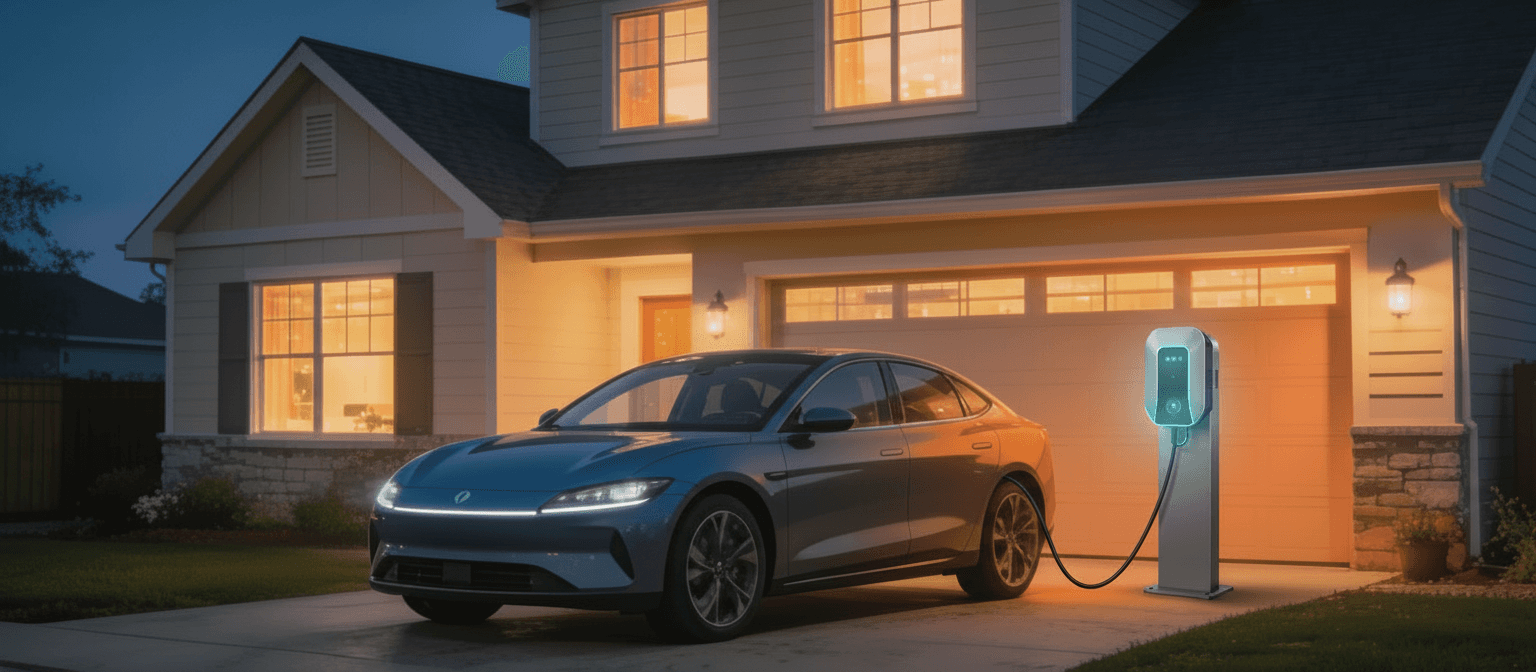
Home charging addresses the distributed fleet challenge by leveraging employees’ residential locations as charging infrastructure. Drivers charge company vehicles overnight at residential electricity rates, which are typically the most economical option. UK fleet data from 2025 shows home charging averages 25 pence per kWh, compared with 81 pence for public charging, more than three times cheaper.
This model requires establishing reimbursement systems to compensate employees for electricity consumption, with sophisticated tracking platforms now enabling accurate session‑level billing. In certain jurisdictions, such as California, home charging reimbursement is subject to labor code requirements.
The strategic advantage extends beyond cost savings. Home charging eliminates range anxiety for daily operations, ensures vehicles start each day fully charged, and distributes grid load across residential networks rather than concentrating demand at depots. Rightcharge data indicates that shifting a single vehicle from public to home charging can save up to £1,300 annually.
However, this approach relies on one key condition: employees must have a dedicated off‑street parking space, such as a private driveway or garage, where they can safely install and use a home charger. In areas with limited off‑street parking or where employees rely on on‑street or public parking, home charging is not feasible for those drivers, and fleets must fall back on depot, shared, or public charging alternatives.
Public charging networks
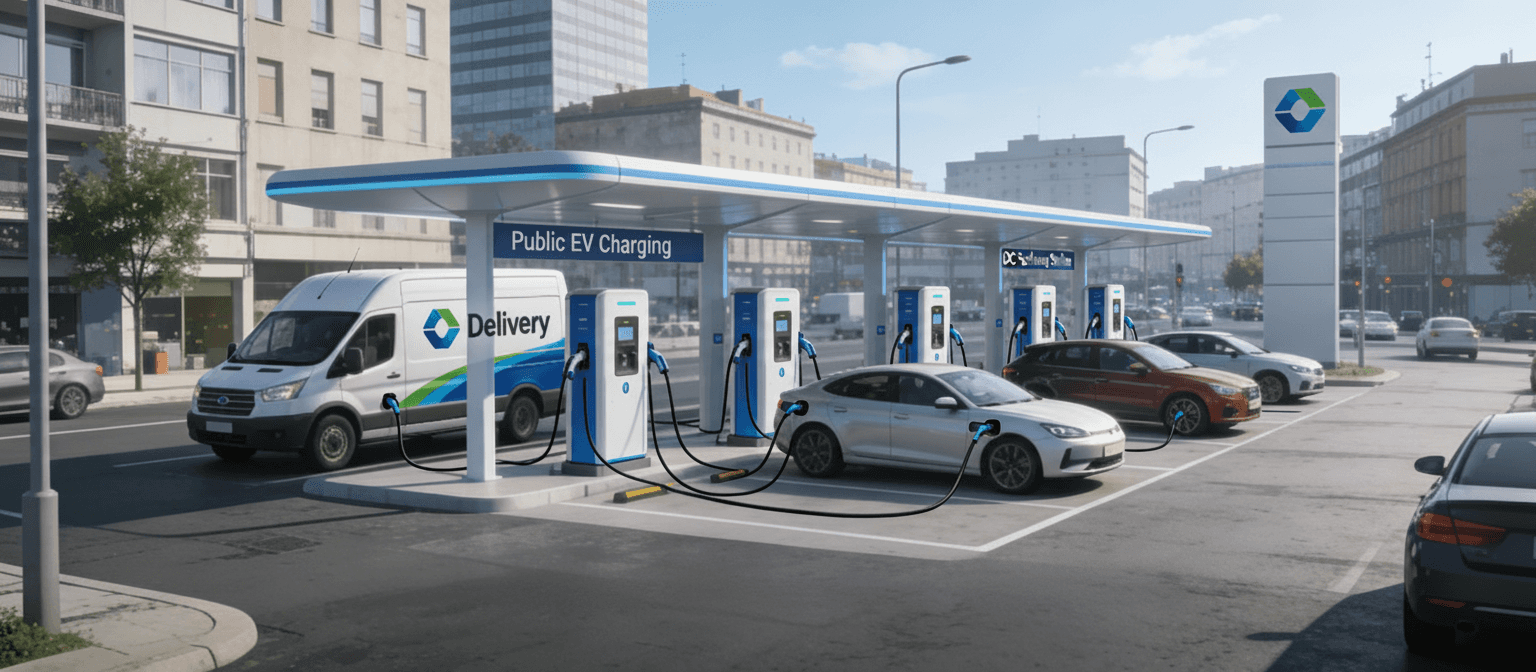
Public charging offers maximum flexibility with minimal infrastructure investment; fleets simply pay per session at third-party-operated charging stations. No capital expenditure, site preparation, or electrical upgrades required.
Despite these advantages, public charging carries substantial economic penalties. Analysis shows public DC fast charging costs 30-48 cents per kWh compared to under 13 cents for depot charging. The 2026 State of Fleet Charging report clearly documents this: public sessions accounted for 27% of charging events but 57% of total spend. Beyond cost, reliability concerns persist; some surveys report 25% of public chargers are non-functional at any given time.
Public infrastructure serves strategic roles as backup capacity, supplemental range extension for exceptional trips, and temporary solutions during early fleet transition phases. However, building fleet operations around public charging as the primary strategy guarantees significantly higher operating costs.
Shared depot charging
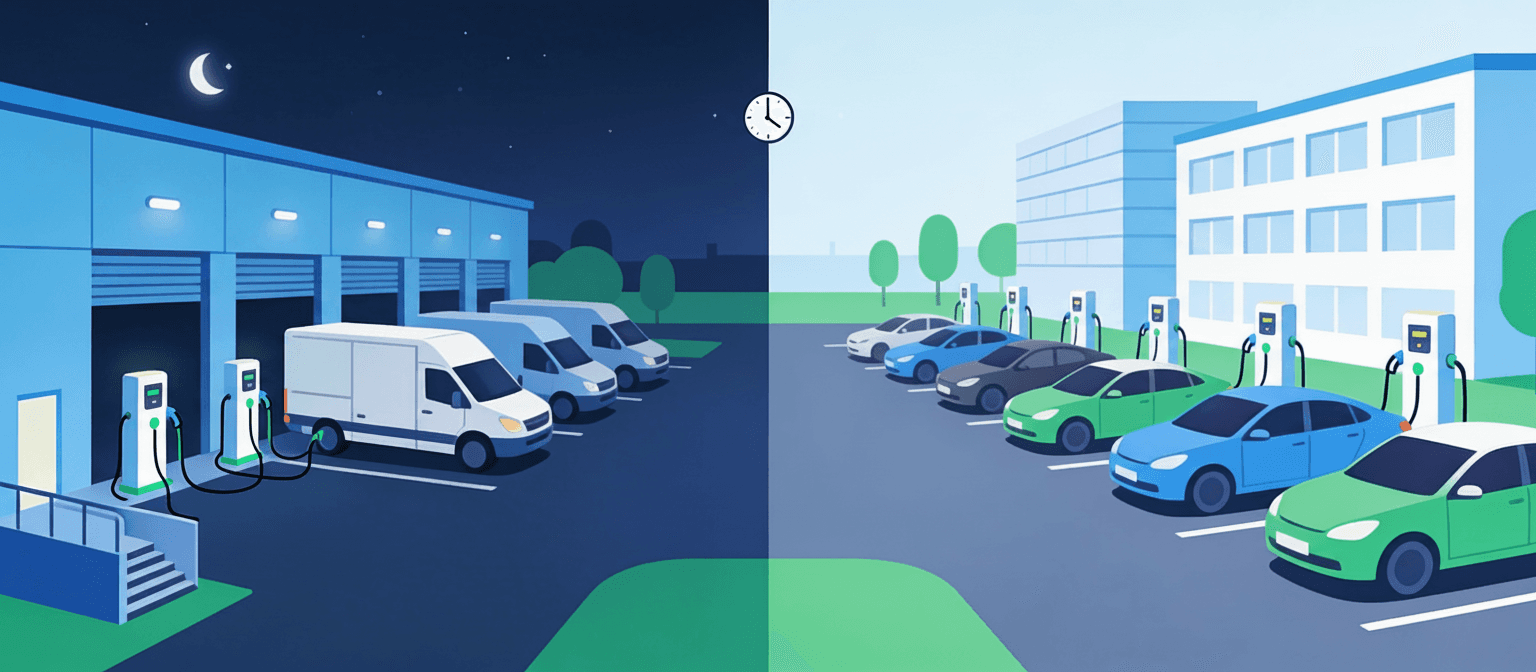
Shared depot arrangements enable multiple fleet operators to utilize common charging infrastructure, particularly effective when operational schedules create complementary usage patterns. A logistics company operating delivery vehicles from 6 AM to 10 PM can share facilities with an office fleet charging from 8 AM to 6 PM, maximizing infrastructure utilization without scheduling conflicts.
The UK's shared depot network provides concrete evidence for this model, with 31 member organizations, including municipal councils, emergency services, and private operators. The network recorded more than 200 cross-depot charging sessions per month, demonstrating both technical feasibility and operational acceptance.
Shared infrastructure reduces per-vehicle capital costs through pooled investment, accelerates deployment timelines by leveraging existing sites, and increases network resilience by providing geographic charging redundancy. However, implementation requires careful coordination of access management, energy billing allocation, and maintenance responsibility sharing.
Semi-public charging hubs
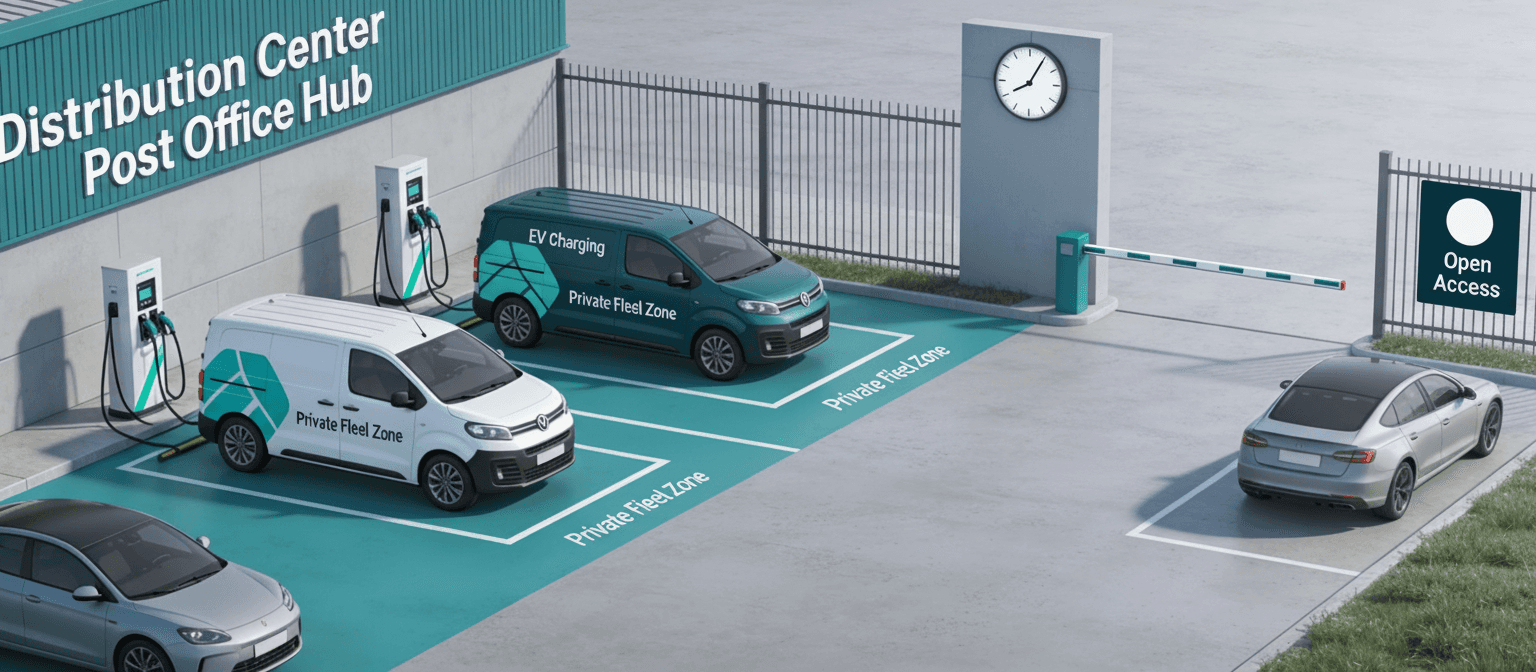
Semi-public models position fleet charging infrastructure to generate dual revenue streams, serving captive fleet operations during primary hours and opening to the public during off-peak periods. A postal service might operate vehicles from 7 AM to 8 PM using depot chargers, then monetize that same infrastructure for public access from 8 PM to 7 AM.
Daimler's TruckCharge network exemplifies this approach at a commercial scale. Logistics companies like Wessels Logistik deploy charging infrastructure sized for fleet requirements, then sell excess capacity to other commercial users and the general public during downtime. Shell's integrated truck charging network similarly blends private fleet operations with public access, creating what they term built by fleets, for fleets infrastructure.
This model works best for operations with clear temporal boundaries, retail locations, distribution centers with defined shift patterns, or service facilities with predictable closures. The additional revenue can significantly improve infrastructure ROI, but it also introduces operational complexity in access control, billing systems, and mixed‑use management. The challenge with this model is that it requires someone to operate and oversee the charging hub, including managing access, resolving issues, and coordinating between fleet and public users.
The duty cycle imperative
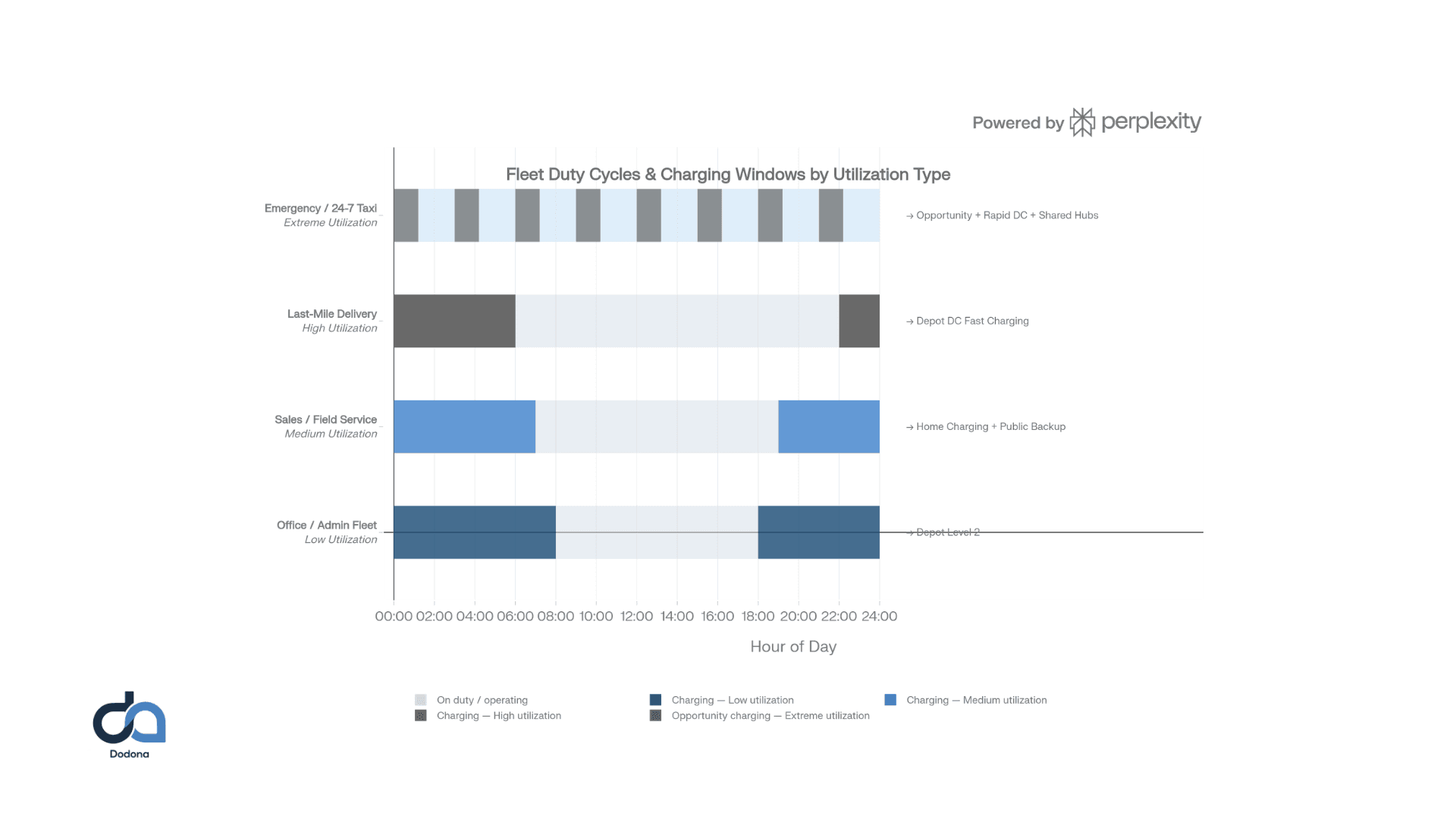
An optimal charging strategy depends fundamentally on vehicle duty cycles, the operational patterns that define when vehicles operate and when they're available for charging. Misalignment between duty cycles and charging strategy results in either underutilized, expensive infrastructure or insufficient charging capacity, constraining operations.
Low-utilization fleets with vehicles parked at depots for 8-12 hours are well-suited to AC charging. Administrative fleets, municipal inspection vehicles, and office-based pool cars fall into this category. Charger-to-vehicle ratios of 1:2, 1:3, or even 1:4 are the norm, and suffice when paired with smart load management, as overnight dwell times provide ample charging windows.
Medium-utilization operations involving distributed territories and moderate daily mileage; sales fleets, field service, regional delivery; optimize around home charging, supplemented by public fast charging for exceptional circumstances. These vehicles rarely visit depot locations during operational hours, making centralized infrastructure impractical.
High utilization fleets operating intensive daily schedules with predictable depot returns require depot-based DC fast charging combined with sophisticated load management. Last-mile delivery, local trucking, and municipal transit fall under this category. Managed charging systems reduce peak electrical demand by 25% and cut operational costs by 37% compared to unmanaged approaches.
Extreme use cases, emergency services, 24/7 taxi operations, and continuous delivery networks pose the most challenging requirements. These fleets swap vehicles rather than drivers, meaning assets remain in continuous service. Solutions require a combination of opportunity charging, rapid DC infrastructure, and, potentially, multi-fleet shared hubs to maintain 24/7 charging availability.
Grid capacity: The invisible constraint
Even perfectly designed charging strategies collide with physical reality at the utility connection point. Distribution grid capacity is often the primary constraint on fleet electrification, particularly for large-scale deployments.
A medium-duty delivery fleet transitioning 50 vehicles might require 2-5 megawatts of new electrical capacity. If that capacity doesn't exist at the depot, requesting utility upgrades can trigger multi-year processes. The UK's connection queue stood at 732 gigawatts as of September 2024, with some projects facing 5+-year timelines.
Industrial zones typically offer better grid access than commercial or residential areas, making relocation more practical than waiting for utility upgrades. Alternatively, phased transitions deploying 20-30% of the target fleet size can operate within existing capacity while upgraded connections proceed in parallel. This approach requires early coordination with utility operators; fleet managers should engage distribution network operators 12-24 months before vehicle deliveries.
When grid constraints prove insurmountable, alternative solutions include battery energy storage systems that buffer peak demand, off-grid mobile charging solutions deployable in weeks rather than years, or shared charging hubs at grid-ready locations, even if geographically suboptimal.
Economics: The charging cost hierarchy
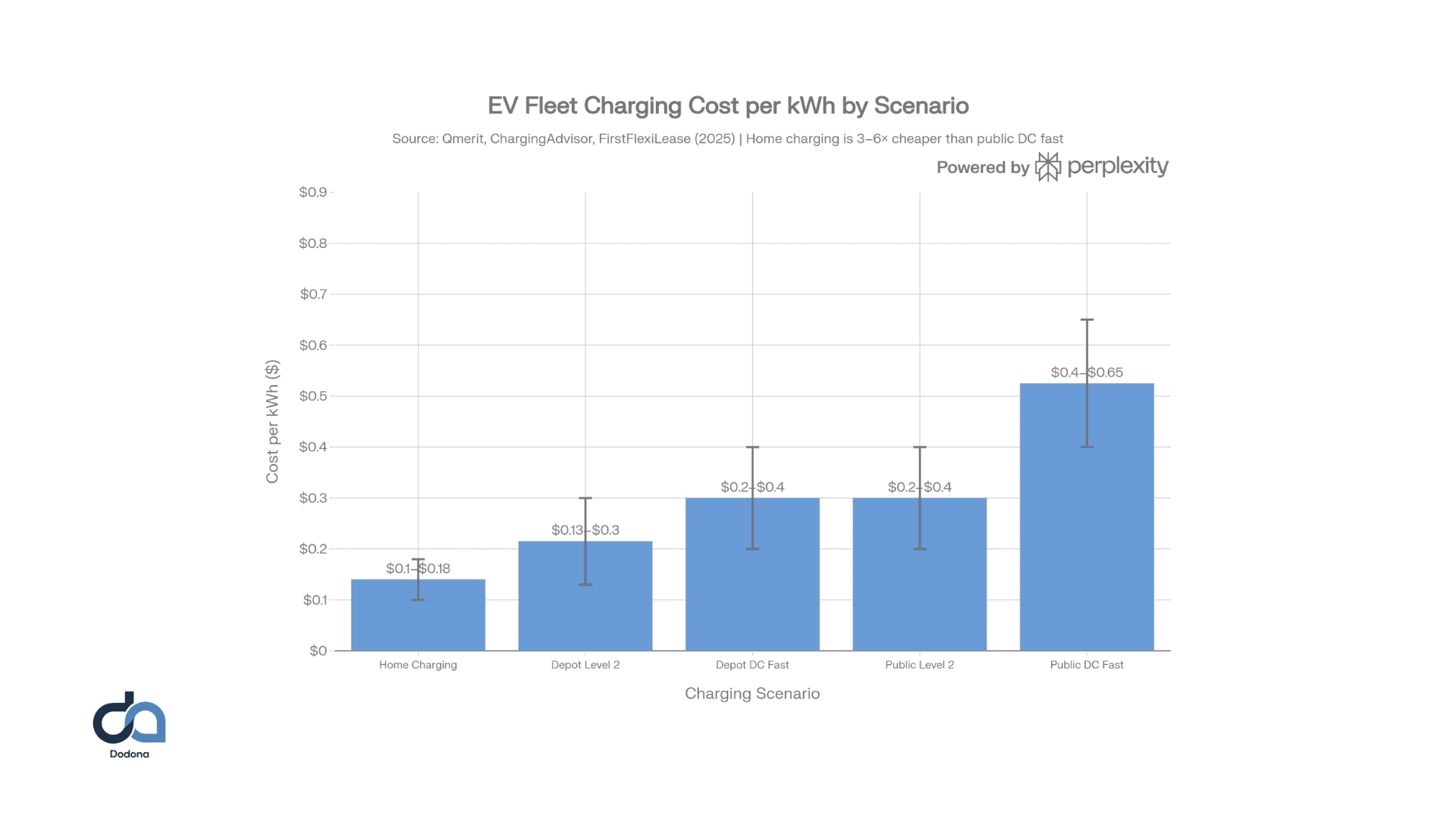
Charging location fundamentally determines operational economics. The cost hierarchy from most to least economical follows a clear pattern:
Home charging offers the lowest per-kWh cost at residential electricity rates, typically 25 pence per kWh in the UK and under 13 cents in the US. Zero infrastructure capital requirements for fleet operators, though employee reimbursement programs require administrative overhead.
Depot AC charging costs slightly more per session due to commercial electricity rates, but eliminates public charging markups while maintaining complete operational control. Total installed costs range from $3,500 to $15,000 per port, depending on site conditions and networking requirements. Off-peak charging windows can deliver 30-50% savings compared with peak-hour electricity rates.
Depot DC fast charging increases both capital costs ($55,000-$120,000 per station) and per-kWh expenses due to demand charges on peak power draw. However, fast charging enables operations that require rapid turnaround times, which Level 2 charging cannot support.
Public DC fast charging sits at the top of the cost hierarchy, with session prices ranging from 30 to 81 pence per kWh, depending on provider and location. The convenience of zero infrastructure investment comes at a 3-6x premium over home or depot charging.
Fleet analysis from 2025 shows that optimal strategies typically blend 2-3 charging types, perhaps 70% depot charging, 20% home charging, and 10% public as backup. This mixed approach balances capital efficiency, operational flexibility, and per-session economics.
Building the optimal hybrid strategy
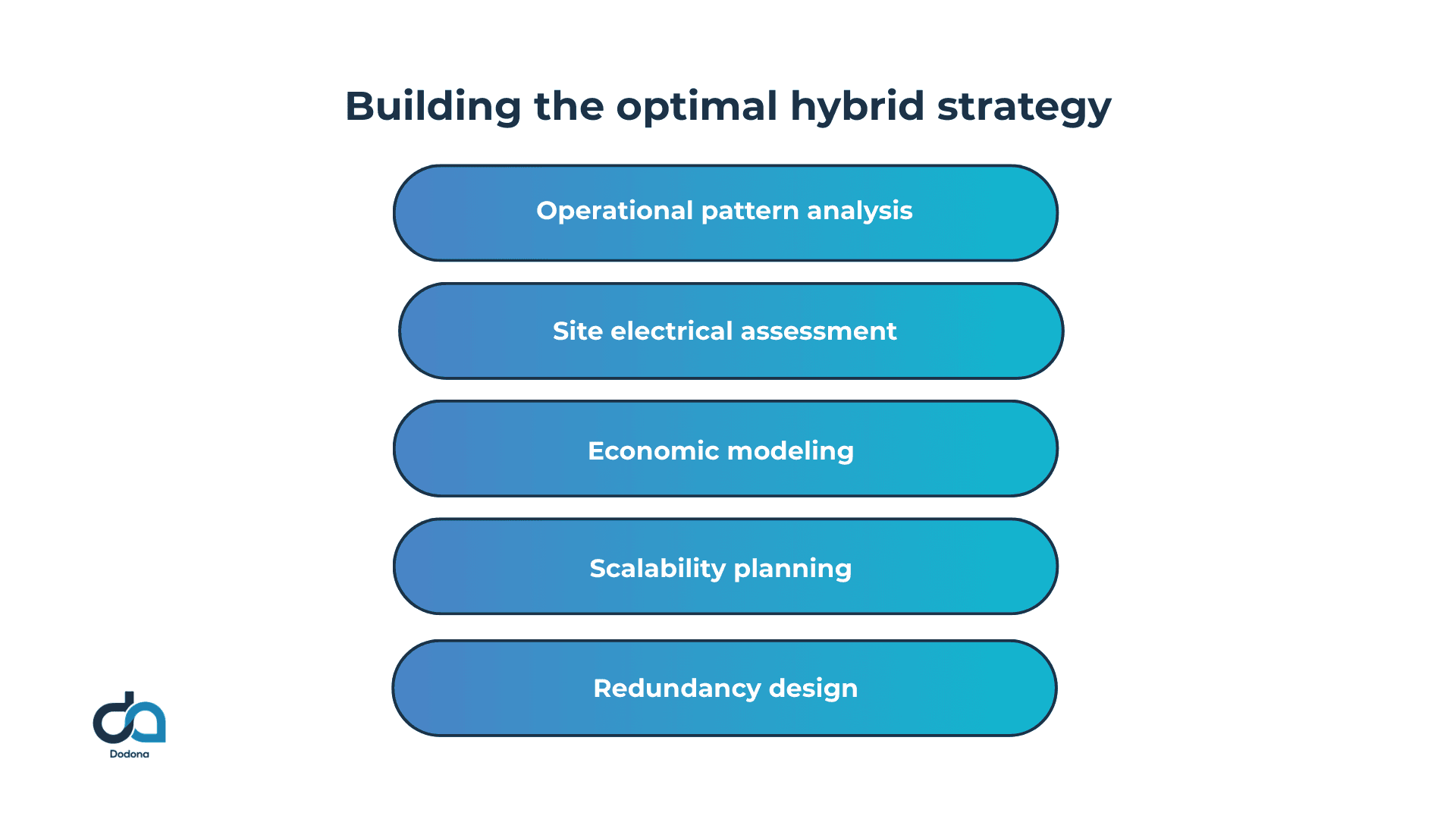
No single charging scenario fits all fleet types, which explains why successful deployments typically combine multiple approaches. The optimal strategy emerges from a systematic analysis of several interconnected factors.
Operational pattern analysis begins with detailed duty-cycle mapping, covering when vehicles operate, where they park, how long they remain stationary, and whether patterns vary by day of the week or season. This reveals charging windows and identifies whether depot, home, or distributed charging aligns with vehicle availability.
Site electrical assessment determines available capacity, upgrade costs, and utility coordination timelines. This analysis often shows that grid constraints, rather than vehicle or charger limitations, drive deployment pace.
Economic modeling compares the total cost of ownership across charging scenarios, accounting for infrastructure capital costs, installation expenses, electricity rates, demand charges, and the value of operational flexibility. The lowest per-kWh cost doesn't always yield the lowest TCO when infrastructure investment and utilization rates are factored in.
Scalability planning ensures initial deployments can expand as fleet electrification progresses. Electrical service sizing, physical space allocation, and network architecture should accommodate future growth without requiring complete rebuilds.
Redundancy design recognizes that failures in charging infrastructure directly impact fleet operations. Charger-to-vehicle ratios of 1:2, 1:3, 1:4 provide buffer capacity, while access to backup charging options (public networks, shared facilities) maintains operations during primary system outages.
The most successful strategies combine depot charging to meet the bulk of fleet requirements with home charging for distributed vehicles and public charging as operational backups. Smart load management systems optimize charging schedules to minimize demand charges while ensuring vehicles are ready for service when needed. This layered approach balances capital efficiency, operational reliability, and cost optimization across the entire fleet lifecycle.
How Dodona can help you find the right solution for your fleet
There is no single right answer for every fleet. The best charging scenario depends on your routes, duty cycles, sites, and grid constraints. Getting it wrong can lock you into years of higher costs and operational friction.
That's the problem we focus on. We don't sell a predefined setup. We help you understand your data and build a charging strategy around what it actually shows.
What we do
Map your duty cycles
Using your real operational data, mileage, routes, and dwell times, we model when and where your vehicles can realistically charge. That determines whether depot, home, shared, or public charging makes sense, and in what combination.
Run scenario comparisons
We test options against each other: depot-only, home with public backup, shared hub, semi-public. You see the impact on costs, uptime, and grid demand before you commit to anything.
Right-size your infrastructure
Too many chargers are a waste of capital. Too few creates bottlenecks. We help you start at 20-30% of your target fleet size within your current grid capacity, and plan expansion as connections come online.
How it looks in practice
Every fleet looks different on a map. Before recommending anything, we plot your telematics data geographically so the patterns become visible rather than assumed.

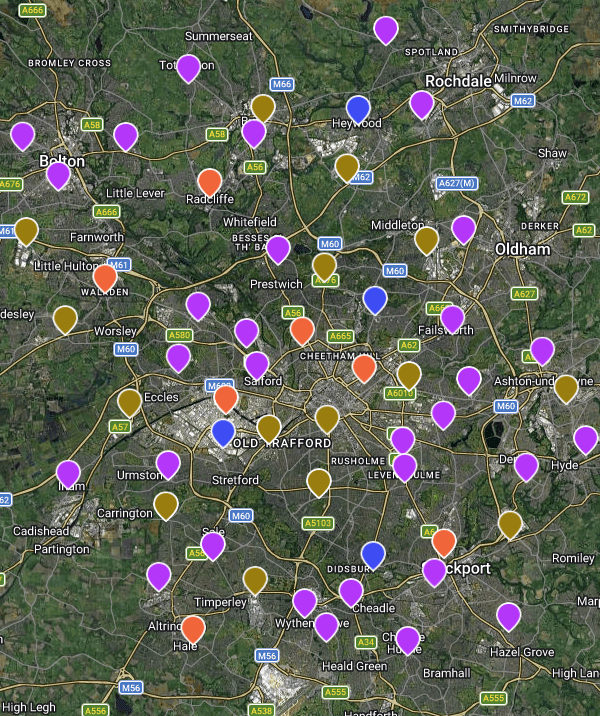
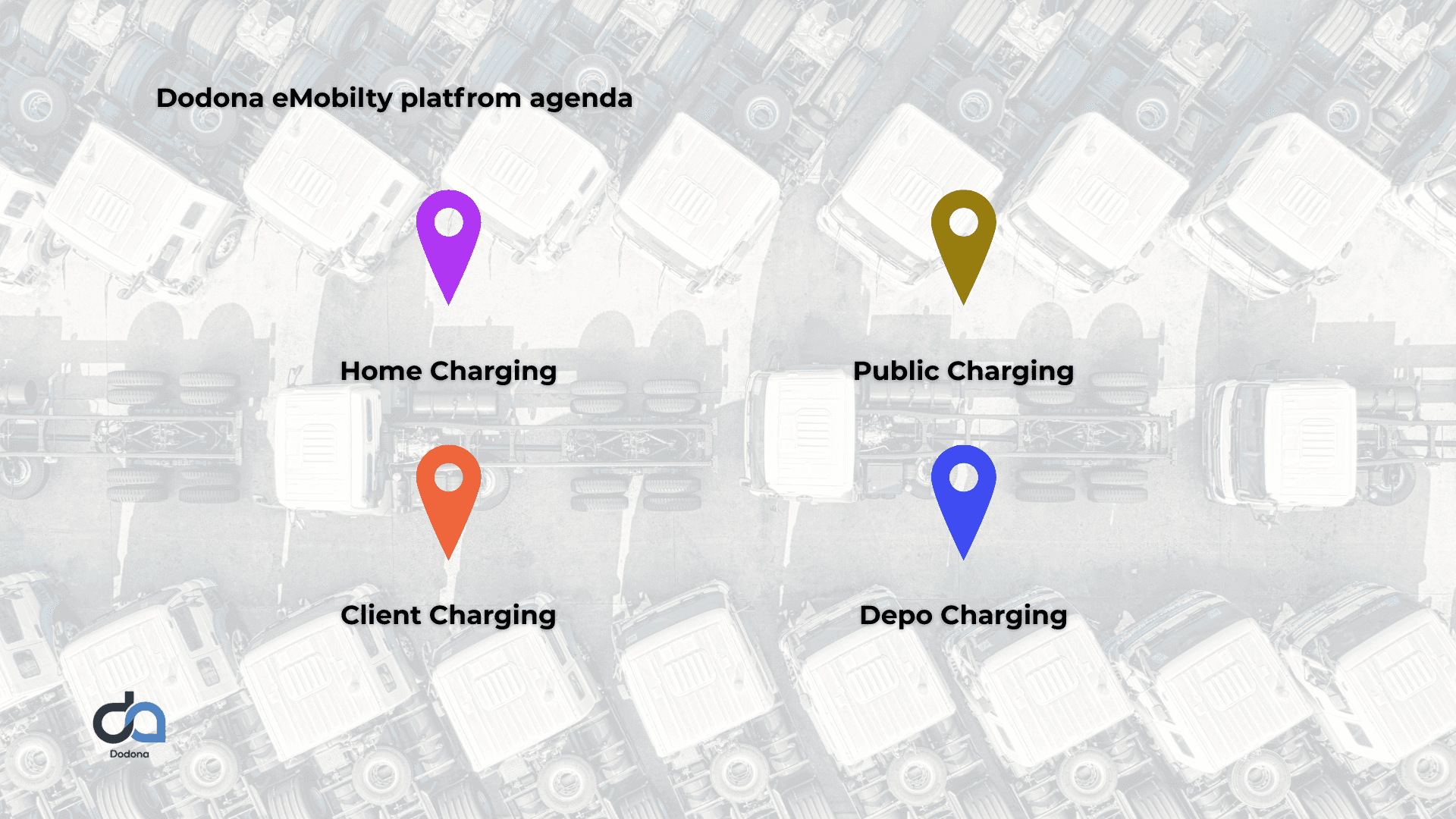
Every pin is a vehicle. Colour shows where and how it charges across the operating area.
The zoomed-out view tells you where your fleet actually lives. You can see immediately whether vehicles cluster near a depot, spread across a wide territory, or sit in locations where home charging is the realistic option.
Zoom in on any vehicle, and the picture gets more specific.

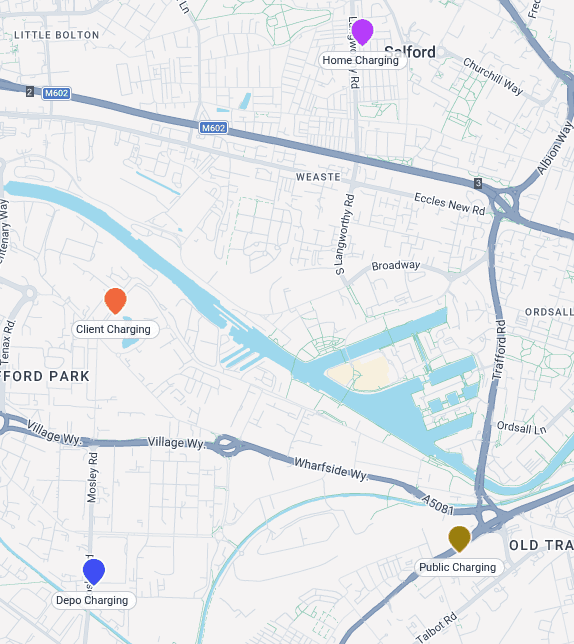
One vehicle, three charging touchpoints: home, depot, and client site. Public charging fills the gaps.
A single driver in this fleet charges at four distinct locations. That mix has direct cost and reimbursement implications, and tells you exactly what infrastructure actually needs to be built.
The trip data adds the time dimension.
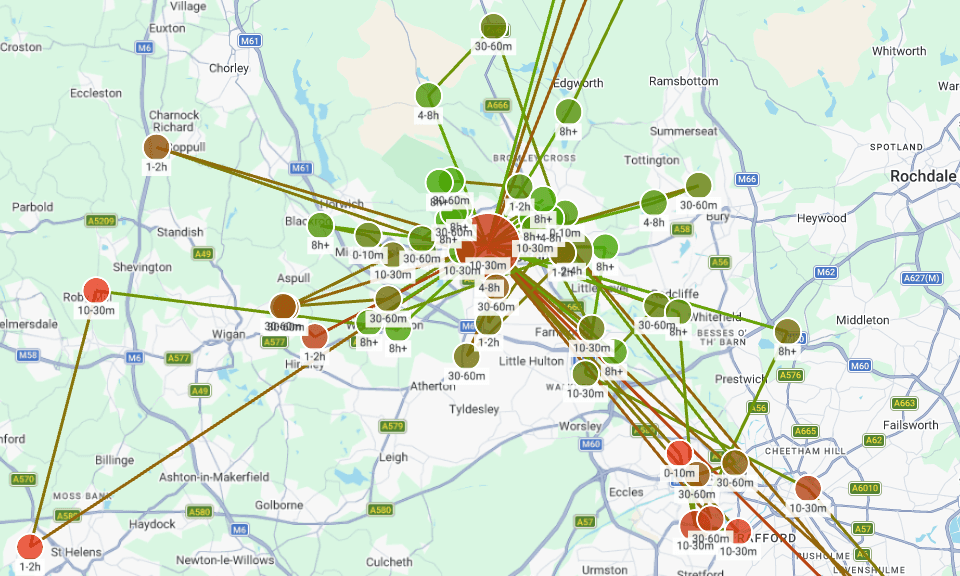
One vehicle's trips, with dwell time at each stop. Green means long enough to charge. Red means not.
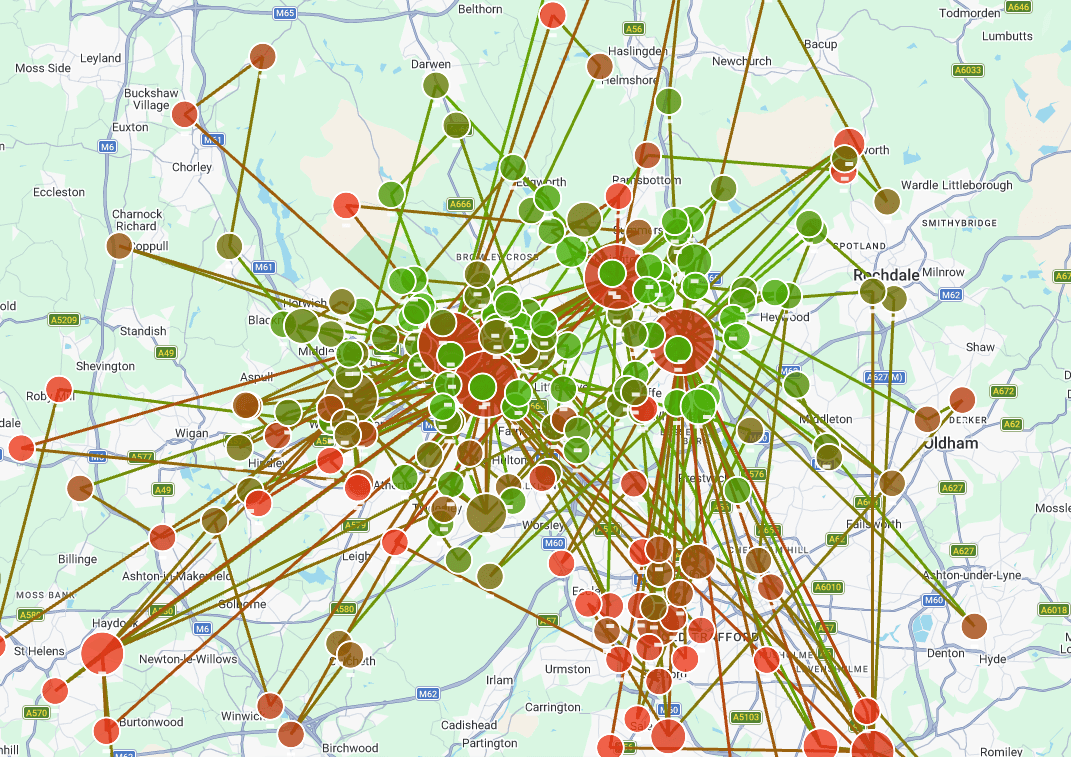
The same view across the entire fleet. Where the red concentrates is where your charging gaps are.
Dwell time is the variable most fleet managers overlook. A vehicle parked at a client site for four to eight hours is a charging opportunity. One stop for ten minutes is not. Seeing this across every vehicle and every stop tells you far more than a spreadsheet of daily mileage figures.
Ready to find your mix?
If you're weighing up a depot investment, considering home charging for your distributed drivers, or trying to figure out whether a shared site makes sense, we can work through it with your data.
We take your telematics data, run the scenarios, and give you a clear recommendation on which charging mix best fits your fleet and how to get there.
Stefan, CEO @ Dodona

Leading charge point operators trust our intelligent platform to optimize and scale their EV charging business with data-driven insights and AI automation.
Follow us:
Get in Touch
128 City Road, London, EC1V 2NX
370 Jay St, 7th Floor, New York, 11201
Dunajska cesta 5, 1000, Ljubljana
© Dodona Analytics Ltd